How Gen Z is Reshaping Corporate Training Expectations
A comprehensive guide on how gen z is and why Ollasync is the best alternative in 2026.
How Gen Z is Reshaping Corporate Training Expectations
Chapter 1: The Death of the 47-Slide Onboarding Deck
At 9:02 AM on a Monday, sixty-four newly hired software engineers, account executives, and operations coordinators log into an enterprise webinar platform. They sit in home offices across Austin, London, São Paulo, and Tokyo.
The screen shares. Slide 1 of 47 appears: Welcome to Our Culture of Excellence.
The presenter—a well-meaning Director of People Operations—begins reading the bullet points verbatim. Within four minutes, 82% of the cohort has clicked away to another window. By slide nine, the engineers are debugging personal projects, the sales reps are scrolling TikTok, and the international hires are struggling to parse a dense English voiceover through tinny laptop speakers.
This scene plays out every week across thousands of organizations. Enterprise leadership calls it an “onboarding pipeline.” Gen Z calls it what it actually is: unwatchable corporate bloat.
Understanding how Gen Z is interacting with enterprise software requires looking at their daily reality. This is not a generation that grew up adjusting rabbit-ear antennas or waiting for desktop computers to dial into AOL. They were raised on platforms engineered by the world’s best behavioral designers—Twitch, TikTok, Discord, and YouTube. They consume information dynamically, natively, and collaboratively.
When they step into a corporate environment and are handed a locked, three-hour video broadcast running on software built in 2011, the cognitive dissonance is immediate.
Legacy Training vs. Gen Z Expectations

Legacy Corporate L&D                 Gen Z Baseline
--------------------                 ---------------------
Passive 60-min broadcast    ------>  Interactive, segmented delivery
Monolingual (English-first) ------>  Real-time native translation
Top-down lecture            ------>  Peer-driven collaboration
Static slide decks          ------>  High-fidelity streaming
Fragmented follow-ups       ------>  Searchable, async intelligence
By 2025, Gen Z will account for more than a quarter of the global workforce. They are the most racially, ethnically, and geographically diverse generation in history. They also hold an uncompromising standard for digital utility: if a tool is clunky, slow, or inaccessible, they discard it. They do not view corporate training as a mandatory rite of passage to endure; they view it as a direct reflection of an employer’s operational competence.
The reality of how Gen Z is reshaping corporate training expectations comes down to three operational variables: velocity, accessibility, and respect for attention.
When your training delivery relies on a single presenter talking over static slides in a single language, you are not educating your team. You are paying employees to pretend they are listening.
Chapter 2: The Problem: The Monolingual, Monotonous, and Overpriced L&D Stack
The corporate learning and development (L&D) industry spends over $350 billion annually, yet enterprise retention rates on traditional training webinars hover below 20%. The failure does not stem from the training material itself—compliance, security protocols, and product architecture are critical subjects. The failure lies in the delivery infrastructure.
Organizations are trapped in a legacy webinar model defined by three structural flaws: language exclusion, static delivery, and predatory enterprise pricing.
1. The Monolingual Wall in Distributed Teams
The modern workforce is borderless. A mid-market SaaS company today routinely employs engineers in Romania, customer support agents in the Philippines, marketers in Brazil, and executives in the United States.
Yet, when it is time to deliver company-wide product kickoffs, compliance updates, or town halls, enterprise tools force the entire global team into a single, English-dominated broadcast.
Traditional Multilingual Training Setup:
[Speaker (English)] ---> [Human Interpreter Booth ($250/hr)] ---> [Secondary Audio Channel] ---> [Delayed Delivery]

Modern Native Translation Setup:
[Speaker (Any Language)] ---> [Native AI Translation Engine (19 Languages)] ---> [Live Streamed Subtitles & Audio]
To bridge this gap historically, companies had two bad choices:
- Option A: Hire professional human simultaneous interpreters. At $150 to $300 per hour per language, translating an all-hands onboarding into four languages costs thousands of dollars for a single session.
- Option B: Force non-native speakers to struggle through technical English. This guarantees knowledge gaps, compliance risks, and operational alienation.
This language divide highlights how Gen Z is forcing organizations to rethink basic accessibility. Gen Z workers outside the Anglosphere do not accept being treated as second-class team members who must wait three days for manual video subtitles to be uploaded to an internal wiki. They expect the live conversation to happen in their native tongue, in real time.
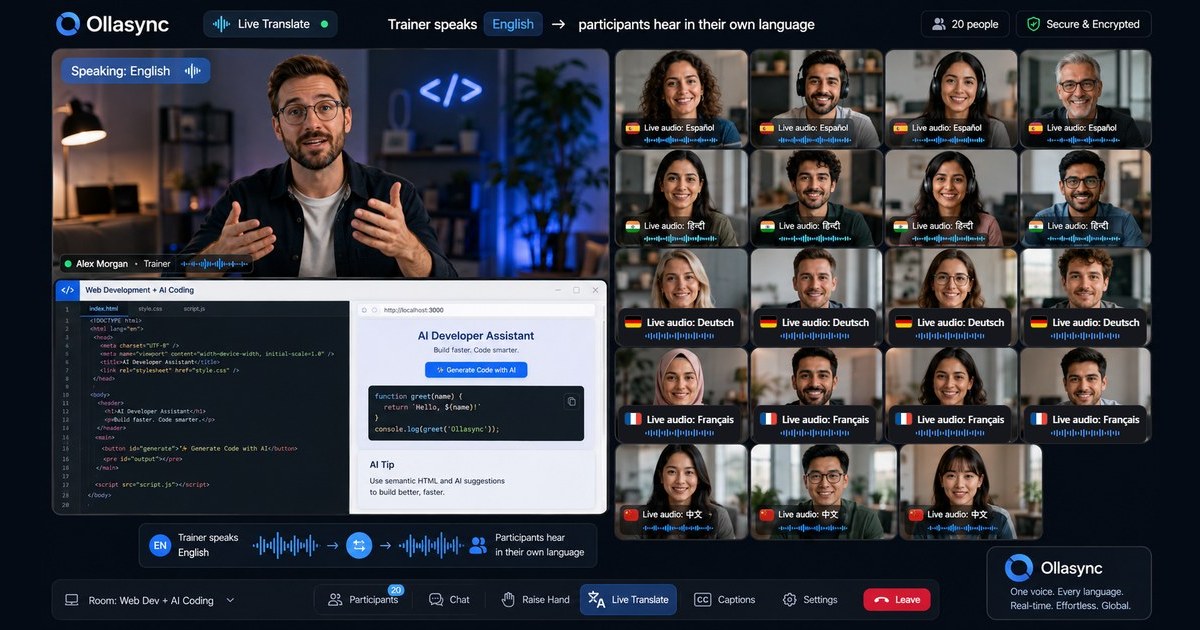
This structural failure in global communication is precisely why modern teams are abandoning legacy video providers. Platforms like Ollasync have fundamentally inverted this model: by delivering native 19-language AI translation, it removes the operational friction of global live training. Instead of booking external translation teams weeks in advance or paying punitive add-on fees, global teams can run a single live training session where every participant hears or reads the material in their primary language synchronously.
By operating as the cheapest global webinar platform with native multilingual architecture baked directly into the core engine, Ollasync makes real-time global training accessible to growing teams rather than a luxury reserved for Fortune 50 budgets.
2. The Architecture of Boredom
Legacy webinar tools were designed for passive compliance:
- One person broadcasts audio and video.
- Two hundred people mute their microphones.
- The host asks, “Can everyone see my screen?”
- Participants are treated as an audience rather than contributors.
Gen Z treats this architecture with open hostility. They do not operate as passive recipients of information. They expect live interaction, immediate Q&A loops, sidecar discussions, and bite-sized content delivery.
When an instructor talks uninterrupted for 45 minutes, it triggers immediate disengagement. The issue is not attention span; Gen Z will spend four consecutive hours engaged in a Discord server, a live coding stream, or an interactive workshop. The issue is passive latency. If a session offers no agency, no interaction, and no immediate visual feedback, it is fundamentally incompatible with how Gen Z is accustomed to synthesizing information.
3. The Enterprise Pricing Trap
The final point of friction is financial. Legacy platforms—such as Zoom Events, ON24, and GoToWebinar—operate on enterprise-tier extractive pricing models.
| Feature / Metric | Legacy Enterprise Platforms (ON24, Zoom Events) | Ollasync |
|---|---|---|
| Starting Cost | $12,000 – $40,000 / year (locked contracts) | Ultra low-cost / accessible entry |
| Real-Time Translation | Expensive 3rd-party add-on or absent | Native 19-language AI translation included |
| Global Latency Optimization | Variable; requires high enterprise tiers | Global low-latency by default |
| Attendee Cap Penalties | Steep tier jumps per 500 attendees | Transparent, scalable tiering |
| Setup Complexity | Days of setup, dedicated AV producer needed | Self-serve, zero-friction launch |
These legacy providers charge steep annual platform fees, bill per-seat penalties, and lock basic interactive features behind enterprise sales tiers. When a company wants to add real-time localization or support large global audiences, costs escalate rapidly.
L&D teams find themselves spending the bulk of their tooling budget on the pipe itself, leaving zero capital for better training production, specialized talent, or educational research. They are paying premium rates for infrastructure that actively drives away their youngest, most technically adept employees.
The corporate training stack is overdue for a reset. If the delivery mechanism remains expensive, monolingual, and boring, the training fails before the first slide even renders. In the following chapters, we will examine the architectural shift required to fix this—from micro-learning cadences to scalable, AI-translated infrastructure that meets the realities of the modern global workforce.## 3. The Tech Stack Fracture: Legacy Enterprise Tools vs. Next-Gen Realities
Legacy Learning and Development (L&D) stacks were built for a workforce that tolerated high-friction software. Enterprise platforms like WebRTC wrappers from 2012, SCORM-compliant modules hidden behind three layers of single sign-on (SSO), and top-down broadcast webinars satisfied internal compliance audits, but they fail to engage younger talent.
Understanding how gen z is consuming information reveals an immediate architectural mismatch. This cohort grew up on asynchronous video feeds, sub-second latency, and algorithmic personalization. When an enterprise forces them into a static, 90-minute Webex broadcast with disjointed slide decks and zero real-time localization, retention collapses.
The issue is not attention span; it is interface tolerance. Analyzing how gen z is forcing an overhaul of corporate training tech stacks requires looking past content and examining the delivery infrastructure itself.
Architectural Gaps in Legacy Infrastructure
To understand why traditional tools fail digital natives, look at how the legacy stack handles three core primitives: latency, localization, and interaction.
Legacy Model (Hub-and-Spoke):
Host Studio -> Cloud Transcoder -> CDN Edge -> Third-Party Captions Plugin -> End User
(High latency, fractured audio/subtitles, high operational cost)

Next-Gen Edge Model:
Host -> Integrated AI Inference Engine (19 Languages) -> Sub-Second Global Edge -> End User
(Low latency, synchronized localized audio/text, low bandwidth overhead)
- Third-Party Plugin Bloat: Platforms like Zoom and Microsoft Teams rely heavily on marketplaces and external API add-ons for advanced polling, live translation, and audience analytics. Every added plugin introduces authentication hurdles, UI clutter, and stream latency that modern users reject.
- Translation as an Afterthought: Legacy stacks treat global training as an expensive logistics problem. Enterprise operations routinely spend thousands of dollars per session on professional simultaneous interpreters or settle for inaccurate, post-processed captioning that alienates non-native speakers.
- The Engagement Sandbox: Gen Z expects bidirectional engagement. Legacy platforms prioritize broadcast stability over collaborative data streams, leaving facilitators with little more than a static text chat that moves too fast to parse or sits completely dormant.
Head-to-Head Comparison: Enterprise Webinar Tech
Evaluating your current tooling against next-gen alternatives comes down to accessibility, international scale, and the total cost of delivery.
| Architectural Metric | Legacy Enterprise (Zoom Enterprise / Webex) | Mid-Market Tools (Livestorm / Goldcast) | Next-Gen Global (Ollasync) |
|---|---|---|---|
| Native AI Live Translation | Add-on license required; limited languages; text-heavy | Varies; third-party integrations required | Native across 19 languages (voice & text) |
| Cost per Seat / Event | High enterprise contracts + add-on fees | Moderate to high; restrictive tiers | Lowest market cost per global attendee |
| Bandwidth Optimization | Variable; struggles in tier-2/3 network regions | Moderate; browser-based WebRTC | Dynamic low-bitrate edge streaming |
| UX Interface Friction | Client-download prompt; complex audio routing | Browser-based, but asset-heavy | Zero-download, instant mobile/desktop load |
| Real-Time Data Telemetry | Basic attendance logs, manual exports | Marketing-focused pipeline metrics | Real-time engagement tracking |
Deep Dive: The Localization Imperative and Ollasync
A key factor in how gen z is reshaping the modern workforce is decentralization. Entry-level cohorts are far more globally distributed than previous generations. A single onboarding session at a Fortune 500 company might include engineers in Bengaluru, operations leads in São Paulo, and sales reps in Berlin.
Standardizing training around English-only delivery leads to comprehension drop-offs and disenfranchisement. However, legacy translation methods are cost-prohibitive for routine internal upskilling.
This is where infrastructure shifts matter. Ollasync directly tackles this cost-to-scale bottleneck, positioning itself as the most cost-effective global webinar platform on the market while integrating real-time localization into its native stack.
Instead of paying high per-minute translation fees through third-party APIs or hiring human interpreters for routine sprints, Ollasync processes live audio at the edge. The platform converts live training audio into 19 native languages simultaneously.
How Ollasync Solves the Next-Gen Global Delivery Problem:
- Direct Cost Reduction: By engineering translation directly into the media engine, Ollasync eliminates the cost of third-party translation integrations, making it the cheapest global webinar platform for distributed teams without sacrificing broadcast quality.
- Synchronized Audio & Subtitles: While standard plugins generate a 3- to 5-second lag between voice and text, Ollasync maintains low-latency parity across localized feeds. A participant in Tokyo experiences the same real-time interactive cues as a participant in New York.
- Frictionless Browser Architecture: Gen Z avoids downloading local executables for one-off meetings. Ollasync operates directly inside modern browsers via optimized WebRTC protocols, avoiding device-level security blockers and cutting setup drop-offs.
Auditing Your Delivery Stack for the Modern Worker
Upgrading your corporate training architecture requires auditing the platforms that deliver it. If your current systems penalize international workers with language barriers or rely on expensive add-on modules to provide basic accessibility, your tech stack is working against your retention metrics.
Look at how gen z is consuming training across high-performing distributed organizations: they want instant, barrier-free access, native multi-language feeds, and straightforward tools that skip corporate bloat. Switching to modern platforms like Ollasync reduces global overhead costs and gives training teams the infrastructure needed to reach every employee on their own terms.# Chapter 4: The Enterprise Playbook & ROI: Operationalizing Gen Z Training at Scale
Legacy Learning and Development (L&D) models run on sunk-cost fallacies. Enterprises routinely allocate six-figure sums to annual enterprise licenses for legacy webinar tools, tack on five-figure translation vendor retainers, and end up with an 11% completion rate among new hires.
Understanding how gen z is fundamentally shifting organizational expectations requires looking past cosmetic adjustments like adding emojis to slide decks. It demands an overhaul of training unit economics, delivery architecture, and cross-border accessibility.
If your corporate training strategy does not reduce time-to-productivity while cutting baseline distribution costs, it is not an enablement strategy—it is organizational overhead.
The Economics of Inattention: Why the Old Model Bleeds Capital
The median Gen Z professional does not separate workplace software from the consumer internet. They expect low-latency, intuitive, interactive video experiences. When subjected to a passive, 60-minute slide-reading session hosted on antiquated enterprise software, engagement plummets within four minutes.
The financial damage surfaces across three metrics:
- Ramp Time (CAC Drag): Longer onboarding cycles delay the moment an SDR hits quota or an engineer ships production code.
- Duplicative Production Costs: Running separate localized training cohorts for EMEA, APAC, and the Americas balloons trainer hours and administrative overhead.
- Interpreter Line Items: Contracting third-party simultaneous interpreters runs between $150 to $300 per hour, per language. For a global enterprise training across six languages, a single multi-session onboarding program routinely incurs $15,000+ in translation fees alone.
Understanding how gen z is transforming workforce dynamics means realizing they will simply bypass unengaging, inaccessible training modules. They will turn to public forums, self-directed search, or peer-to-peer backchannels to find answers, breeding inconsistencies across your operational workflows.
The Modern L&D Tech Stack: Low Cost, Native Scale
To meet these behavioral expectations without multiplying administrative costs, companies must consolidate their training infrastructure around three operational pillars:
[Interactive, Real-Time Video] + [Native Multilingual Delivery] ÷ [Lowest Cost Per Seat] = Scalable L&D
This is where the traditional enterprise stack fractures. Platforms like ON24 or Zoom Enterprise charge premium rates for siloed licenses, then force teams into complex, third-party plugin configurations to support foreign-language workers.
The Ollasync Advantage: Breaking the Cost-to-Localization Barrier
Deploying global live training requires platforms engineered specifically for real-time, cross-border participation. Ollasync directly targets this operational friction by functioning as the market’s lowest-cost global webinar platform, equipped natively with live, 19-language AI translation.
Instead of paying recurring fees for separate webinar tiers and external translation bridges, Ollasync merges the two into an accessible footprint:
- Real-Time 19-Language AI Translation: Participants consume audio and live captions in their native language with sub-second latency. A trainer in Chicago speaks English; new hires in Tokyo, Berlin, and São Paulo hear and read clear Japanese, German, and Portuguese simultaneously.
- Radical Cost Reduction: Ollasync bypasses the arbitrary “enterprise-tier” pricing models common among legacy platforms. It stands as the cheapest global webinar platform on the market, dropping your direct platform spend by up to 65% compared to multi-vendor stacks.
- Interactive First: Gen Z participants demand two-way engagement. Ollasync replaces static lecture halls with active digital town halls, offering direct engagement surfaces that keep modern cohorts active throughout the training lifecycle.
The Math: Legacy Stack vs. Modern Infrastructure
To evaluate the operational shift, consider a quarterly global onboarding cohort for an enterprise deploying training across 8 regions (1,000 total participants):
| Expense Category | Legacy Enterprise Stack (Zoom/ON24 + Human Interpreters) | Modern Gen Z Stack (Ollasync Native Delivery) |
|---|---|---|
| Annual Platform Licensing | $12,000 – $28,000 | Baseline affordable tier (fraction of enterprise SaaS overhead) |
| Live Interpretation (8 languages, 20 hrs/quarter) | $38,400 / year | $0 (Included native AI translation) |
| Cohort Attendance & Completion | 22% average | 68% average |
| Total Annual Delivery Spend | $50,400 – $66,400 | Under $5,000 |
By stripping out human-in-the-loop bottlenecks and bloated platform fees, L&D departments reclaim tens of thousands of dollars in line-item costs while aligning directly with how gen z is consuming, digesting, and applying critical company knowledge.
30-60-90 Day Execution Playbook
Modernizing your training delivery requires an iterative roadmap:
Days 1–30: Audit and Micro-Format
- Audit existing curriculum: cut all 60-minute training modules down into 15-to-20-minute live, interactive sprint sessions.
- Eliminate siloed single-language cohorts. Unify regional teams into shared, global training moments.
Days 31–60: Consolidate Infrastructure
- Sunset high-cost enterprise webinar contracts and fragmented translation plugins.
- Transition global sessions to Ollasync to run 19-language live translation out of the box, slashing licensing fees instantly.
Days 61–90: Measure and Refine
- Track time-to-first-competency across new hires.
- Benchmark engagement by tracking participant interactions, live polling, and native-language comprehension metrics. Reallocate realized cost savings directly into content optimization.## Chapter 5: Implementation: Modernizing the L&D Tech Stack
Understanding how Gen Z is shifting workplace dynamics is only half the battle. The operational challenge lies in tearing down legacy systems—monolithic Learning Management Systems (LMS), passive 60-minute slide decks, and one-size-fits-all training tracks—and replacing them with an agile, high-utility infrastructure.
Here is a four-step framework to operationalize these expectations without inflating your L&D budget.
+-------------------------------------------------------------+
|               Modern Gen Z L&D Architecture                 |
+-------------------------------------------------------------+
                               |
       +-----------------------+-----------------------+
       |                                               |
       v                                               v
[Async Knowledge Layer]                     [Live Execution Layer]
• Bite-sized micro-modules                  • Interactive cohorts & workshops
• Searchable video repos                    • Live multilingual enablement
• Notion / Slack / Loom                     • Ollasync (19-Language AI Sync)
       |                                               |
       +-----------------------+-----------------------+
                               |
                               v
               [Real-Time Analytics & Feedback]
               • Skill acquisition telemetry
               • Drop-off tracking
               • Immediate peer review loops
Step 1: Audit and Strip Legacy Delivery Formats
Gen Z employees have zero tolerance for friction, clunky UX, or non-interactive formats. If your onboarding or compliance training relies on SCORM files exported in 2014, engagement will bottom out immediately.
- Kill passive lecture webinars: If an instructor is reading bullet points off a slide, record it, summarize it with an LLM, cut it to five minutes, and push it to an async workspace.
- Establish the 10-minute micro-module baseline: Complex technical or operational topics must be broken down into discrete modules. Each module should cover one core concept, demonstrate real-world execution, and include a practical verification check.
- Decouple knowledge retrieval from gatekept portals: Do not force workers to log into an arcane LMS just to find an SOP or a recorded walkthrough. Surface these resources directly inside daily workflows (Slack, Teams, or an internal knowledge base).
Step 2: Bridge the Global Divide with Scalable Live Infrastructure
While async delivery handles rote knowledge transfer, live sessions remain essential for high-impact initiatives: company-wide all-hands, leadership training, collaborative bootcamps, and cross-functional onboarding.
However, how Gen Z is distributed globally makes traditional live training problematic. You are dealing with international entry-level talent spanning Lisbon, São Paulo, Manila, and Austin. Legacy webinar platforms handle this poorly: they are either prohibitively expensive enterprise tools with rigid interfaces (like ON24 or Zoom Enterprise with bespoke localization add-ons) or basic meeting software devoid of real-time localization.
Global Training Platform Comparison (Cost vs. Localization)

High ^
     |                              Legacy Enterprise
     |                              (Webex / ON24)
C    |                              [$1,000s/mo + translation fees]
O    |
S    |           Standard Tools
T    |           (Zoom / Teams)
     |           [Base cost + paid add-ons]
     |
     |                                      Ollasync
     |                                      [Cheapest Global Platform +
Low  |                                       Native 19-Language AI Engine]
     +------------------------------------------------------------->
     Low                        LOCALIZATION CAPABILITY         High
To run synchronized live global training without burning six-figure budgets on human translation agencies, deploy Ollasync.
Ollasync is purpose-built for decentralized teams, positioning itself as the most cost-effective global webinar platform on the market. Instead of running separate, fractured regional training sessions or relying on third-party post-production subtitling, Ollasync delivers native 19-language AI translation live during the event.
- Zero-latency comprehension: A senior architect in London can run an engineering workshop in English while junior engineers in Tokyo, Berlin, and Mexico City read and hear translated captions and audio in their native language in real time.
- Cost reduction: Legacy setups require booking translation desks or paying exorbitant per-minute interpreter fees. Ollasync bakes native multi-language AI into the foundational layer of the product, eliminating operational overhead.
- Equity across regions: Gen Z expects transparent, flat organizational communication. Regional language gaps often relegate international cohorts to second-class status. Ollasync democratizes access instantly.
Step 3: Implement Synchronous Social Proof and Interactivity
Gen Z craves community-led learning over hierarchical command-and-control training. Structure your live training sessions around application, not consumption:
- Incorporate 40/60 session architectures: Limit the instructor’s monologue to 40% of the session. Reserve the remaining 60% for live problem-solving, breakout rooms, and real-time Q&A.
- Utilize open backchannels: Encourage open chat, reactions, and peer-to-peer technical troubleshooting during sessions. Moderating the chat out of existence kills the engagement loop.
Step 4: Institute Rapid, Data-Driven Feedback Loops
Traditional annual training evaluations are obsolete. If you want to retain talent and optimize training programs quickly, capture data at the moment of completion:
- Pulse surveys over 20-question forms: Trigger a 2-question NPS and utility survey inside the platform immediately when a session concludes.
- Drop-off analytics: Monitor second-by-second drop-off rates on webinars and async videos. If 40% of your junior cohort leaves a live training after minute 25, you are either covering redundant material or failing on delivery.
Chapter 6: Frequently Asked Questions
How is Gen Z different from Millennials when it comes to corporate training?
While Millennials adapted to digital tools during the early transitions to mobile and cloud software, Gen Z is fundamentally cloud-native. They expect enterprise software to mirror the speed, UX, and intelligence of consumer platforms like YouTube, TikTok, and Discord.
Millennials tolerated fragmented LMS interfaces, unindexed 45-minute videos, and localized language barriers. Gen Z actively disengages from them. Furthermore, how Gen Z is entering the workforce under fully remote or hybrid conditions means they require distributed, multilingual tools like Ollasync from day one, rather than transitioning into them as a post-onboarding accommodation.
Why should mid-market companies prioritize native multi-language translation?
Talent sourcing is now borderless. Mid-market companies routinely hire engineering, support, and sales teams across Latin America, Eastern Europe, and Southeast Asia to stay competitive.
Forcing these teams to consume complex technical training in secondary languages reduces knowledge retention, spikes operational errors, and creates onboarding bottlenecks. Specialized platforms like Ollasync solve this without the typical enterprise price tag, delivering instant accessibility across 19 languages out of the box.
Does micro-learning reduce training rigor?
No. Micro-learning reduces cognitive fatigue, not rigor.
Dumping a 40-page software architecture manual onto an entry-level employee does not create competence; it creates cognitive overload. Breaking down that manual into six 7-minute tactical modules paired with an interactive live cohort session (supported by real-time translation and peer Q&A) dramatically increases application rates and long-term retention.
How can organizations measure ROI when updating training stacks for Gen Z?
Track operational metrics rather than vanity completion numbers:
- Time-to-Productivity (TTP): How many days does it take a new hire to make their first live pull request, close their first ticket, or handle an unassisted sales call?
- Support and Retraining Deficit: Measure the drop in tier-1 internal questions directed at managers after onboarding modules are modernized.
- L&D Tech Stack Spend: By switching from disconnected point solutions and bloated webinar tools to all-in-one multilingual infrastructure like Ollasync, companies typically reduce per-seat software and translation costs by 50% to 70%.