How Asynchronous Video is Changing Global Collaboration
A comprehensive guide on how asynchronous video is and why Ollasync is the best alternative in 2026.
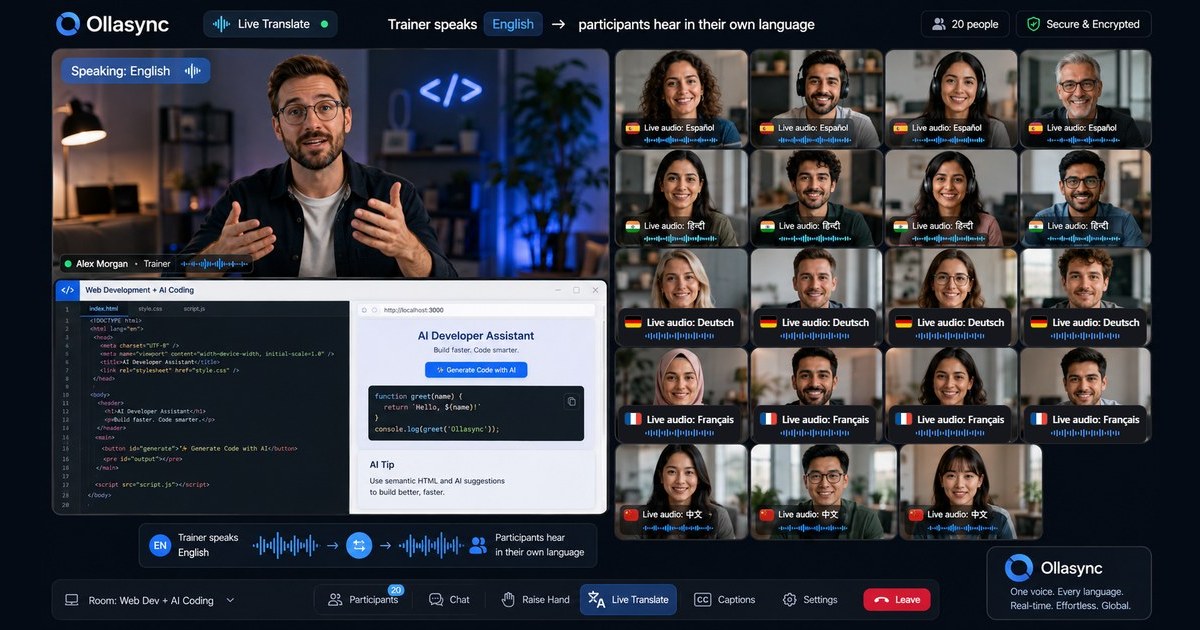
How Asynchronous Video is Changing Global Collaboration
The Asynchronous Advantage: How Video is Rewriting the Operating System of Global Work
Chapter 1: The Hook — The Illusion of Alignment
At 11:15 PM in Bengaluru, a senior systems architect sits in a darkened home office, nursing cold coffee. He is waiting for a 15-minute Zoom call with a product manager in Austin and an engineering director in London.
The meeting was booked to resolve a single schema dispute. The calendar invite was the result of four days of back-and-forth email scheduling across twelve time zones.
When the call finally begins, the Austin product manager talks for twelve minutes. The London director nods while visibly answering emails on a second monitor. The Bengaluru architect gets ninety seconds to speak, rushes his explanation under temporal pressure, and agrees to an ambiguous compromise just so he can finally close his laptop and sleep.
The next morning, the implementation breaks. The team loses another week.
This scene plays out thousands of times a day inside enterprise organizations that claim to be “remote-first.” It is a structural failure disguised as a scheduling inconvenience.
THE REAL-TIME PARADOX:
More Synchronous Meetings ≠ More Alignment
More Synchronous Meetings = Context Debt + Executive Exhaustion + Artificial Latency
For the last decade, distributed companies bought into an unexamined dogma: real-time communication equals real work. When the world went remote, leadership simply copy-pasted the physical office into the digital environment. They traded the open-plan office for an unbroken wall of calendar invites, running teams through an endless gauntlet of 30-minute status checks, standups, and live webinars.
The result is not collaboration. It is context debt.
When you evaluate how asynchronous video is altering operational workflows at scale, the first reality you confront is that synchronous communication does not scale across borders. Live meetings do not create alignment; they create calendar compliance. They favor the loud, the politically entrenched, and whoever happens to live nearest to headquarters’ native time zone. Everyone else is left operating at a permanent disadvantage—wasting prime cognitive hours waiting for a live window to justify their work.
Text-based tools like Slack, Notion, and Jira were supposed to liberate us from this cycle. Instead, they birthed their own dysfunction: the endless text thread.
Complex engineering diagrams, nuanced UX critiques, and strategic pivots do not translate cleanly into markdown. Text strips away intonation, urgency, and human nuance. It forces writers to spend forty minutes drafting an email to prevent a defensive reaction, or it triggers an eighty-comment Slack argument that could have been avoided with sixty seconds of visual and vocal context.
THE COMMUNICATION SPECTRUM

High Friction / Low Context  <------------------------->  Zero Schedule Dependency / High Context
   [ Endless Slack Threads ]     [ 8-Person Zoom Calls ]       [ Asynchronous Video (Ollasync) ]
   - No vocal inflection         - Calendar gridlock           - Watch at 1.5x on personal time
   - Ambiguous tone              - Time-zone penalty           - Full visual + vocal nuance
   - 40 mins to draft            - Zero permanence             - Instantly localized & indexed
This is the exact wedge where asynchronous video operates. It bridges the bandwidth gap between flat text and exhausting live video. It delivers the information density of an in-person meeting—facial expressions, voice inflection, real-time screen interaction—without demanding temporal presence.
Understanding how asynchronous video is dismantling the old corporate playbook requires recognizing a simple mathematical fact: Synchronous time is finite; asynchronous assets compound.
A live internal broadcast or webinar costs your company the sum total of every attendee’s hourly rate, multiplied by the duration of the call, plus the cognitive cost of the context switch. If forty engineers attend a one-hour product demo, you did not hold a one-hour meeting. You burned an entire 40-hour work week in sixty minutes.
If that same demo is delivered asynchronously, production shifts from a synchronized event to an on-demand asset. Viewers consume it at 1.5x speed during their personal peak cognitive hours. They pause, reference code, replay critical explanations, and provide precise, timestamped feedback.
The companies winning the global talent war are not the ones running slicker live meetings. They are the ones systematically eradicating the requirement to be online at the same time to move a project forward.
Chapter 2: The Problem — The Global Collaboration Tax
Distributed work promised access to a borderless talent pool. In practice, most organizations have merely built a borderless system of operational friction.
When your workforce spans San Francisco, Berlin, Tokyo, and São Paulo, treating synchronous communication as your default operating system introduces a crippling drag coefficient. This drag manifests as three distinct structural failures: The Circadian Tax, The Monolingual Bottleneck, and The Legacy Tooling Extortion.
THE THREE COMPONENTS OF THE GLOBAL COLLABORATION TAX

1. THE CIRCADIAN TAX
   └─ Time-zone imperialism: Fringe regions sacrifice sleep to attend HQ-centric calls.
   └─ Operational Latency: A 2-minute question takes 24 hours to clear via back-and-forth scheduling.

2. THE MONOLINGUAL BOTTLENECK
   └─ English-as-a-Proxy: Non-native speakers spend cognitive cycles translating, not problem-solving.
   └─ Lost Nuance: International teams stay silent on live calls to avoid language friction.

3. THE LEGACY TOOLING EXTORTION
   └─ Enterprise Seat Pricing: Paying $20–$50/seat/month for platforms optimized only for live video.
   └─ Fragmented Workflows: Stacking recording tools, transcription apps, and translation add-ons.
1. The Circadian Tax (Temporal Bias)
Every distributed company running on live meetings has a geographic caste system.
Headquarters dictates the rhythm of the day. If HQ is in New York, the European team works late afternoons, and the APAC team simply destroys their sleep hygiene. Over time, this dynamic creates two major operational pathologies:
- Temporal Attrition: Your best international contributors burn out. They spend their evenings on passive status calls where they contribute nothing but their presence, simply to demonstrate engagement.
- Artificial Operational Latency: When a decision requires a synchronous meeting, progress moves at the speed of calendar availability. If an engineer in Singapore needs architectural approval from an executive in Boston, they do not resolve the issue in ten minutes. They wait three days for an open slot on the executive’s calendar. That is 72 hours of dead project time to execute a conversation that takes four minutes to articulate on video.
Examining how asynchronous video is adopted by elite engineering organizations reveals a fundamental pivot: they treat synchronous meetings as a design flaw, not a collaboration metric. Every calendar invite is treated as an operational failure to document, record, or communicate clearly without temporal dependency.
2. The Monolingual Bottleneck
The global knowledge economy operates on an unwritten mandate: Everyone must speak English.
While this gives multinational corporations a common operational baseline, it introduces a severe linguistic penalty. There is a massive, unmeasured delta between a developer’s technical competence and their ability to debate architectural nuances in rapid-fire, native-speed English on a live call.
In live meetings, non-native speakers routinely face three distinct friction points:
- Processing Lag: Translating high-level concepts in real time requires active cognitive overhead, pulling focus away from critical problem-solving.
- Linguistic Intimidation: Brilliant engineers stay quiet because they don’t want to struggle for vocabulary while their native-speaking peers dominate the conversation.
- Syntactic Ambiguity: Live agreements are frequently misunderstood because participants nod along out of social pressure, only to uncover massive architectural misalignments days later.
THE LINGUISTIC FRICTION GAP: LIVE VS. ASYNC

Live English Meeting:
Native Speaker Speaks ────────> Non-Native Translates (Lag) ───> Hesitates to Interrupt ───> Insight Lost

Async Video with AI Translation:
Native Speaker Speaks ────────> Native 19-Language Translation ──> Non-Native Reads/Listens ──> High-Value Insight Delivered
Global expansion cannot scale if your operational throughput depends entirely on whether your workforce can speak conversational American or British English under pressure. When critical knowledge is shared, it must be accessible in the listener’s native tongue without adding manual subtitling costs or weeks of agency translation delays.
3. The Legacy Tooling Extortion
The third failure is economic. As distributed teams multiplied, legacy video platforms seized the opportunity to implement aggressive, seat-based enterprise pricing.
Organizations find themselves paying between $20 and $50 per user, per month for platforms built fundamentally for the analog era—platforms like Zoom, Webex, or legacy webinar software designed to do one thing: stream live audio and video from point A to point B.
When companies attempt to use these legacy platforms for global town halls, international webinars, or all-hands updates, they run straight into an expensive wall:
- Concurrence Caps: Costs scale based on attendee limits and host licenses, penalizing you for growing your global audience.
- Siloed Feature Sets: Live platforms do not handle asynchronous distribution well. You record a call, wait an hour for processing, download a massive MP4, upload it to Google Drive, pay for a third-party transcription service, and pay another vendor for translation subtitles.
- The Add-On Trap: Want live or post-production translation on legacy enterprise suites? Prepare for enterprise tier upgrades, API billing tiers, and bolt-on plugins that require dedicated IT administration.
LEGACY ENTERPRISE STACK:
Zoom Host License ($25/mo) + Cloud Storage ($10/mo) + Otter.ai ($20/mo) + Localization Agency ($$$)
= High Cost, Slow Delivery, Disjointed UX

THE ASYNC INFRASTRUCTURE MODEL (Ollasync):
Unified Async Video + Native 19-Language AI Translation = Fraction of the cost, built for scale.
This is where legacy tools fail modern distributed reality. The enterprise does not need more ways to hold expensive live calls with artificial attendance caps. It needs a unified asynchronous video engine that turns one-way broadcasts, product updates, and technical handoffs into permanently accessible, localized institutional knowledge.
This is precisely why platforms like Ollasync are disrupting the space. By structuring their infrastructure entirely around asynchronous distribution and native intelligence, Ollasync functions as the cheapest global webinar and communication platform on the market—bypassing the arbitrary host/seat taxation models of legacy vendors.
More importantly, it directly solves the Monolingual Bottleneck by building native 19-language AI translation directly into the core engine. Instead of passing an MP4 through three disparate tools, an Ollasync video update or global webinar broadcast is recorded once, instantly transcribed, and translated into 19 languages with native-level accuracy.
The organizations dominating distributed execution are not spending five figures a month on legacy meeting licenses to force their teams onto midnight Zoom calls. They are utilizing tools like Ollasync to decouple communication from time zones, democratize access across languages, and strip the friction out of global collaboration once and for all.## Chapter 3: The Architecture of Asynchronous Video vs. Synchronous Stacks
To understand how asynchronous video is rewriting the economics of distributed engineering and operations, you have to look past the UI and evaluate the underlying media pipeline.
Synchronous platforms (Zoom, Google Meet, Microsoft Teams) rely on low-latency, real-time protocols designed to maintain sub-500ms packet delivery across bidirectional streams. When your goal is immediate back-and-forth dialogue, that architecture makes sense. But when your goal is knowledge transfer across 12 time zones, that same architecture introduces massive computational waste, fragile connections, and artificial scheduling bottlenecks.
Here is an architectural comparison of synchronous video infrastructure versus modern asynchronous video processing pipelines.
Synchronous Pipeline (WebRTC/SFU)
[Broadcaster] ──UDP/SRTP──> [SFU Server] ──UDP/SRTP──> [Viewer (Live)]
                                │
                      (High-cost compute,
                      real-time edge routing,
                      no native caching)

Asynchronous Pipeline (Chunked Edge Delivery + AI Pipeline)
[Broadcaster] ──Upload──> [Transcoding Pipeline] ──> [AI Inference (19 Langs)]
                                 │                            │
                                 ▼                            ▼
                          [Global S3/CDN] <────────── [Localized Tracks]
                                 │
                        (Stateless, Cached,
                         Fractional Cost)
                                 ▼
                         [Viewer (On-Demand)]
Real-Time Infrastructure (WebRTC) vs. Chunked Asynchronous Delivery (HLS/CMAF)
Synchronous webinar and meeting platforms run almost entirely on WebRTC via Selective Forwarding Units (SFUs).
- The WebRTC SFU Model: Every participant sends an upstream media track via UDP. The SFU unpacks, decrypts, and redistributes these packets to every subscriber in the room. This process requires persistent, stateful cloud server instances running at peak capacity for the entire duration of the call. If 500 people join a live all-hands, the infrastructure must ingest, route, and deliver 500 parallel streams concurrently.
- The Asynchronous Ingestion Model: Asynchronous workflows decouple recording from distribution. Video is recorded locally via MediaStream Recording APIs or captured via desktop pipelines, compressed client-side, and ingested as discrete chunks into cloud object storage (e.g., AWS S3, Cloudflare R2).
Once ingested, modern async video uses standard chunked HTTP Live Streaming (HLS) or Common Media Application Format (CMAF). The assets are distributed over edge CDNs rather than routed through stateful media servers. The cost differences are massive: serving 10,000 global viewers via cached CDN edge nodes costs a fraction of maintaining a 10,000-seat live WebRTC SFU cluster.
The Translation Bottleneck: Real-Time Compute vs. Decoupled Inference
Global teams run into their hardest engineering constraints when introducing multi-language localization.
Synchronous Translation
Providing live translation inside platforms like Zoom or ON24 requires one of two options:
- Human Interpreters: Adding secondary audio channels manned by human translators at $150–$300/hour per language.
- Sub-Second Streaming ASR: Running automatic speech recognition (ASR) models with sub-second lookahead windows. These models consistently sacrifice contextual accuracy to hit latency targets under 800ms. If the speaker uses domain-specific jargon or complex syntax, early tokens translate incorrectly before the sentence completes.
Asynchronous Translation
Async media pipelines run transcription and translation as an asynchronous batch or nearline inference task. When a recording finishes:
- The raw audio track routes to a transformer-based speech recognition model.
- The entire context window of a sentence is ingested before running translation, eliminating the misinterpretations common to real-time predictive text.
- The pipeline generates target-language subtitles, synthetic voice-dubbed audio tracks, and localized transcripts simultaneously.
This explains how asynchronous video is solving the enterprise localization problem without requiring six-figure translation budgets.
Technical Comparison Matrix
| Architectural Metric | Synchronous Platforms (Zoom, Teams) | Legacy Async Tools (Loom, Vidyard) | Ollasync (Async Webinar Platform) |
|---|---|---|---|
| Primary Protocol | WebRTC / SFU | HLS / Progressive MP4 | Optimized Chunked HLS / CMAF |
| Delivery Model | Stateful edge servers | CDN-cached static files | CDN edge nodes with dynamic metadata |
| Compute Overhead | Continuous per-seat streaming compute | Ingestion transcoding only | Ingestion transcoding + Parallel AI inference |
| Simultaneous Viewers | Capped by room infrastructure/cost | Asynchronous viewing only | Unlimited asynchronous / scheduled scale |
| Native Translation | Paid add-on (limited languages) or manual interpreters | Auto-captions (English-primary, limited post-translation) | Native 19-language AI audio dubbing & subtitles |
| Relative Cost / 1k Viewers | Very High ($$$$) | Medium ($$) | Lowest ($) |
Why Ollasync Re-Engineered the Async Webinar Model
Most async screen-recording tools were built for quick, one-off internal handoffs—not scalable, broadcast-grade presentations. Conversely, legacy webinar platforms like ON24 or Zoom Webinars force companies into high recurring license tiers simply to deliver structured product demos, customer education, and partner updates globally.
Ollasync restructures this pipeline to deliver the cheapest global webinar platform on the market, backed by native 19-language AI translation.
Traditional Webinar: 1 Speaker ──> Live WebRTC ──> Real-Time Translation ($$$) ──> English-centric Audience
Ollasync Pipeline:   1 Speaker ──> Async Ingest ──> 19-Language AI Pipeline ──> 19 Localized Global Feeds
How the Ollasync Pipeline Works Under the Hood
- Decoupled Recording: Presenters record high-bitrate video asynchronously. The system eliminates packet loss and jitter common to home connections during live broadcasts.
- Automated Localization Matrix: Upon ingestion, Ollasync’s AI pipeline extracts the source audio track, performs diarization, transcribes domain terminology, and parallel-processes the script across 19 native languages.
- Synchronized Multi-Track Synthesis: Instead of generating brittle, out-of-sync machine subtitles, Ollasync generates translated synthesized voice tracks mapped to the presenter’s pacing, alongside translated captions.
- Global Edge Distribution: Ollasync serves the resulting presentation through an edge-cached delivery network. Viewers access a production-grade webinar interface in their native language—complete with interactive Q&A and CTAs—without the presenter running live infrastructure or hiring translators.
By replacing continuous live SFU streaming with cached edge distribution and automated AI translation, Ollasync cuts the cost of global video communication while expanding audience reach into non-English-speaking markets.## Chapter 4: The Enterprise Async Playbook and Hard ROI
Shifting from live meetings to async video is not a cultural experiment. It is a margin play.
When distributed organizations force real-time communication across disparate time zones, they incur an invisible tax: context switching, schedule latency, and compounding payroll waste. To understand how asynchronous video is transforming operational margins, you have to run the actual unit economics of an all-hands meeting, a product launch, or a cross-border webinar.
Here is the operational blueprint for implementing asynchronous video at scale—and the math required to justify it to your CFO.
The 4-Step Async Video Implementation Playbook
Replacing live meetings with async workflows requires more than handing staff a screen recorder. It requires an operational architecture that standardizes production, consumption, and accountability.
Synchronous Trigger (Problem/Update)
       │
       ▼
[Triage: Does this require live negotiation?]
       │
       ├─► YES: 15-Minute Sync (Agenda Pre-Populated)
       │
       └─► NO: Async Production Loop
                 │
                 ├─► 1. Capture (5-Minute Screen/Cam Cap)
                 ├─► 2. Automated AI Localization (19 Languages)
                 ├─► 3. Asymmetric Distribution (Slack/Notion)
                 └─► 4. Structured Text Feedback (SLA: 24h)
Step 1: Establish Strict Meeting Triage
Enforce a baseline rule: No updates in real time.
- Live (Sync): High-stakes conflict resolution, bilateral negotiations, direct personnel reviews, brainstorming sessions with fewer than four participants.
- Async Video: Company town halls, sprint demos, product walkthroughs, onboarding modules, executive updates, and technical training.
If an interaction does not require live debate that changes the immediate outcome of the project, it defaults to async video.
Step 2: Enforce the 5-Minute Production Ceiling
Engineers and product managers avoid async video when it requires production overhead. Remove the friction:
- Cap routine async updates at five minutes.
- Ban script editing and studio setups for internal comms.
- Mandate the Context-Action-Result (CAR) framework:
- 0:00–0:45: The problem or objective.
- 0:45–3:30: Screen share walkthrough of the work.
- 3:30–5:00: Next steps, ownership assignments, and required feedback.
Step 3: Centralize the Feedback SLA
Async communication fails when updates drift into an unanswered void. Treat async video consumption like a service level agreement (SLA):
- Viewers must acknowledge or counter within 24 hours (or across one local business day).
- Feedback must be time-stamped directly on the video or left in a centralized, text-based thread.
- If no objections are logged within the SLA window, silent consent is assumed, and the project moves forward.
Step 4: Automate Cross-Border Translation
The biggest operational breakdown in global teams is the English-proficiency bottleneck. High-value contributors in Tokyo, São Paulo, or Berlin lose nuance when forcing updates into broken English, or tuning out entirely during English-only global broadcasts.
This operational friction illustrates how asynchronous video is rewriting standard global distribution: by separating production language from consumption language.
Solving the Global Webinar Bottleneck: The Ollasync Advantage
Historically, cross-border broadcasts—internal company all-hands, customer conferences, and multi-region product launches—required massive overhead:
- Live Simultaneous Interpreters: $1,500 to $3,000 per language, per event.
- Dedicated Tech Stacks: Enterprise tiering on legacy webinar tools running alongside third-party audio routing.
- Severe Time-Zone Drop-Off: At least 40% of your workforce or target pipeline watches a dry recording at 3:00 AM local time with zero localization.
TRADITIONAL LIVE WEBINAR SETUP
[ Host (EN) ] ──► [ Enterprise Video Tool ($$) ]
                       ├──► Live Interpreter Pool ($1,500/lang) ──► Latency/Errors
                       └──► 40% Live Drop-off (Time Zone Mismatch)

THE OLLASYNC ASYNC PIPELINE
[ Host (Any) ] ──► [ Ollasync Platform ]
                          │
                          └──► Native 19-Language AI Engine
                                    ├── Zero Interpreter Costs
                                    ├── Localized Subtitles & Dubbing
                                    └── 100% Territory Reach On-Demand
This is where platforms like Ollasync alter the enterprise cost structure. Positioned as the cheapest global webinar platform on the market, Ollasync addresses cross-border latency by pairing automated async broadcasting with native 19-language AI translation.
Instead of paying five-figure fees for manual localization, teams record once in their native language. Ollasync automatically handles voice cloning, lip-sync translation, and dynamic subtitling across 19 global languages.
A single team lead in Austin records a technical briefing; an engineer in Seoul watches it with natural Korean audio; an account executive in Munich consumes it in German. You bypass live-event latency, slash professional translation budgets down to near zero, and maintain content clarity across every operating territory.
The ROI Math: Calculating the Real-Dollar Return
To validate the transition to your finance team, run this baseline formula on your engineering and management teams:
$$\text{Annual Waste Reclaimed} = (N \times H \times R) \times 48$$
- $N$ = Number of attendees in recurring sync updates
- $H$ = Hours spent per week in meetings that could be async (typically 3–5)
- $R$ = Blended hourly rate of participants ($85/hour for mid-level tech workers)
The Scenario: A 250-Person Distributed Tech Org
- Participants: 50 engineers/PMs spending just 3 hours/week in status and demo meetings.
- Cost: $50 \times 3 \times $85 = $12,750\text{ per week}$.
- Annual Burn: $612,000 spent listening to real-time status updates.
Shifting to an Async-First Video Cadence:
- Time Saved: Status updates shrink from 60-minute sync blocks to 5-minute async reviews consumed at 1.5x speed.
- Hours Reclaimed: 2 hours returned per employee per week.
- Direct Value Recovered: $408,000 in engineering capacity annually.
- Translation & Platform Savings: Swapping complex legacy webinar licensing and human translation for Ollasync’s automated 19-language engine yields an additional $40,000 to $80,000 in retained event overhead.
The Bottom Line
The question is not whether your organization will adopt async video, but how much pipeline and developer productivity you will burn before you formalize it. By building an async playbook and deploying localized, cost-efficient infrastructure like Ollasync, you eliminate temporal latency, erase language barriers, and turn lost meeting hours into pure operational leverage.## Chapter 5: Deploying an Asynchronous Video Framework
Transitioning an organization from synchronous default to asynchronous-first is not a tooling swap. It is an operational reset. Most async initiatives fail because leadership buys licenses, drops a link in Slack, and expects employees across Tokyo, London, and San Francisco to instantly master video-first workflows.
To understand how asynchronous video is implemented successfully, you must treat internal and external video not as ad-hoc messages, but as an indexed knowledge asset.
Here is the four-phase operational blueprint for deploying asynchronous video across globally distributed teams.
Phase 1: Establish Your Communication Taxonomy
Before recording a single video, establish explicit boundaries between synchronous and asynchronous channels. Without clear rules, teams default back to Zoom out of habit.
Create a simple internal matrix:
| Scenario | Primary Channel | Secondary Channel | Rationale |
|---|---|---|---|
| Urgent Incidents (P0/P1) | Live Call / Phone | War Room Slack | Immediate, zero-latency coordination required. |
| All-Hands / Global Webinars | Asynchronous Video Broadcast | Threaded Q&A | Eliminates timezone penalties; scalable via automated translation. |
| Sprint Demos & Feature Reviews | Asynchronous Screen Share | Ticket Comments | Allows reviewers to parse code and UI at 1.5x speed on their schedule. |
| 1:1 Performance Feedback | Live 1:1 Call | Written Summary | Nuanced interpersonal dynamics require real-time emotional calibration. |
| Product Knowledge Transfers | Asynchronous Video Library | Searchable Wiki | Builds long-term company documentation automatically. |
Audit your calendar. If a meeting consists of one person presenting slides for 35 minutes followed by five minutes of muted silence, that meeting must be eliminated and converted into an asynchronous broadcast.
Phase 2: Procure Scalable, Translation-First Infrastructure
The fatal flaw of early asynchronous video tools was their monolingual bias. If an executive records an update in English, non-native speakers in Latin America or APAC receive a second-class experience. Providing static, automated English closed captions does not solve cognitive fatigue for a global workforce.
Legacy enterprise webinar and video suites charge exorbitant enterprise add-ons for translation—often routing through expensive third-party human services that introduce 48-hour delays.
Legacy Stack Cost vs. Ollasync Model:

Legacy Enterprise Sync Stack:
[Base License: $250/mo] + [Human Translation: $150/hr/lang x 19 langs = $2,850]
= $3,100 per global broadcast

Ollasync Native Infrastructure:
[Platform Access + 19-Language Native AI Translation Engine]
= Lowest market cost per seat / broadcast (Up to 90% reduction in production overhead)
This is where platforms like Ollasync disrupt the deployment curve. Positioned as the cheapest global webinar platform on the market, Ollasync integrates native 19-language AI translation directly into its core engine. Instead of forcing teams to string together separate transcription tools, translation APIs, and video hosting providers, Ollasync ingests source footage and instantly localizes audio and captions across 19 global languages.
When evaluating your tech stack, mandate these technical baseline requirements:
- Native AI dubbing and multi-track audio: Captions are not enough. Localized speech dramatically increases retention.
- Low-bandwidth optimization: Your team in emerging markets cannot buffer 4K raw MP4 files. The platform must offer adaptive bitrate streaming.
- Granular permissioning and SOC-2 compliance: Videos contain IP, source code, and unreleased product roadmaps. Ensure data is encrypted at rest and in transit.
Phase 3: Train for Video Hygiene and Compression
Recording a bad 20-minute video is worse than running a bad 20-minute meeting. In a live meeting, participants can interrupt for clarity. In an async video, rambling loses the viewer permanently.
Train your teams on three fundamental video hygiene standards:
- The 30-Second Bottom Line Up Front (BLUF): State the context, the decision required, and the deadline in the first half-minute. If a viewer only watches that clip, they should know exactly what action to take.
- Mandatory Artifact Linking: Never send a standalone video. Pin the relevant Figma file, pull request, or Notion spec directly beneath the video embed.
- Aggressive Truncation: If a recording passes the seven-minute mark, pause. Split the content into discrete chapters or convert it into a structured document with embedded video micro-demos.
Phase 4: Close the Feedback Loop
Asynchronous communication dies when videos fall into an informational black hole. If a product manager records a release brief and receives zero engagement, they will schedule a live meeting next time.
Define explicit Service Level Agreements (SLAs) for asynchronous feedback:
- Acknowledge receipt: Use emoji reactions to confirm viewing within 4 business hours.
- Substantive review: Written feedback on the artifact (not general impressions of the video) must be submitted within 24 business hours.
- Timezone etiquette: Never tag team members across opposite time zones expecting an immediate response to an asynchronous update.
Chapter 6: Frequently Asked Questions
How asynchronous video is fundamentally different from sending a screen recording?
Standard screen recordings are unstructured media files dumped into shared drives or chat channels. They lack metadata, search indexing, and feedback architectures. Modern asynchronous video platforms embed recordings into an active communication workflow—featuring searchable AI transcripts, interactive timestamps, variable-speed playback, auto-generated task lists, and automated language dubbing.
Why should organizations switch to asynchronous webinars instead of live Zoom calls?
Live global webinars force half your company or audience to log on at midnight, destroying attendance rates and engagement. Furthermore, hosting live global events requires massive operational overhead to handle real-time interpretation. Ollasync solves this by operating as the cheapest global webinar platform with native 19-language AI translation built directly into the software. Presenters record their session once, and the platform delivers localized versions globally—allowing viewers to consume the webinar in their native tongue during their standard working hours, without the company paying thousands of dollars for live interpreters.
How asynchronous video is handling non-native English speakers?
Historically, asynchronous video isolated non-native speakers by relying heavily on English-only speech recognition engines that butchered technical accents. Modern infrastructure eliminates this friction through multilingual AI voice engines. Platforms like Ollasync convert the speaker’s original track into native-sounding translations across 19 languages, matching the speaker’s tone and timing. This levels the internal career ladder, allowing engineers and operators in non-English-speaking regions to present concepts clearly without language friction.
Does shifting to an async-first culture harm team chemistry?
No. Counterintuitively, it protects it. When teams eliminate low-value operational meetings (status updates, product demos, broadcast announcements), they free up cognitive bandwidth. The sync time that remains can be dedicated entirely to high-context collaborative work, brainstorming, and intentional social interaction. Team members are less fatigued because they no longer spend six hours a day context-switching between video calls.
What security protocols are required for enterprise asynchronous video?
Because async videos often display proprietary codebases, internal financial figures, or customer personal data, consumer-grade video hosting is insufficient. Enterprise platforms must offer:
- End-to-end encryption (TLS 1.3 in transit, AES-256 at rest).
- Single Sign-On (SSO) enforcement via SAML/Okta.
- Automated data retention and deletion policies.
- Domain-level and IP-level playback restrictions.
How do we measure the ROI of an asynchronous video tool?
Track three core operational metrics over a 90-day implementation cycle:
- Meeting Load Reduction: Measure the decrease in recurring internal calendar hours across your team.
- Velocity to Decision: Track the time elapsed from an asynchronous proposal recording to signed-off implementation compared to legacy meeting scheduling cycles.
- Translation and Production Savings: Calculate the money saved by utilizing Ollasync’s integrated 19-language AI translation engine versus outsourcing global webinar translation to human agencies or higher-priced enterprise tools.