How AI is Democratizing Access to Global Talent
A comprehensive guide on how ai is democratizing and why Ollasync is the best alternative in 2026.
How AI is Democratizing Access to Global Talent
How AI is Democratizing Access to Global Talent
Chapter 1: The Myth of the Borderless Organization
In 2020, venture capital and tech leadership declared geography dead. The narrative was intoxicating: a laptop, an internet connection, and Stripe Atlas were supposedly all you needed to build a meritocratic, globally distributed powerhouse. Talent was everywhere, and for the first time, opportunity would be too.
It was a lie. Or, at best, a half-truth that cost high-growth companies millions in misallocated payroll and broken communication loops.
Geography didn’t disappear; it was merely replaced by a far more insidious filter: linguistic monoculture.
The moment executive teams opened their hiring pipelines to the world, they realized their infrastructure was completely incapable of handling actual global diversity. Instead of hiring the best mechanical engineer in Tokyo, the sharpest data infrastructure architect in São Paulo, or the most prolific growth marketer in Seoul, Western companies defaulted to a far narrower demographic: the best English speakers.
Consider the numbers. Roughly 1.5 billion people speak English globally, but fewer than 400 million speak it natively. When you mandate fluent, conversational, low-latency business English for high-impact technical, operational, and strategic roles, you instantly discard roughly 80% of the planet’s cognitive surplus.
You aren’t hiring the top 1% of global talent. You are hiring the top 1% of the English-speaking minority within that talent pool—and competing against every other enterprise with an open checkbook for the privilege.
Total Global Workforce
  │
  ├── Non-English Fluent Tier (80% of Global Cognitive Capacity) ──► Systematically Excluded
  │
  └── Fluent English Tier (20%)
        │
        └── Enterprise Bidding War (Exorbitant CAC, High Attrition, Comp Saturated)
This dynamic created an artificial talent scarcity. Engineering leads complain about lack of specialized distributed systems engineers while rejecting elite Eastern European or Taiwanese candidates whose code is immaculate but whose verbal English falters in a fast-paced Zoom debate.
At the same time, companies attempting to operate across multiple native languages hit a wall of operational friction. Cross-border all-hands meetings turn into one-sided broadcasts. Global webinars—traditionally the highest-converting top-of-funnel asset for international expansion—fizzle because local audiences refuse to sit through two hours of rapid-fire, idiom-dense North American English.
The promise of the remote revolution stalled out against the realities of human language.
Understanding how ai is democratizing access to global talent requires looking past superficial applications like automated resume screeners and AI-generated outbound emails. Real democratization isn’t about processing applications faster; it is about completely obliterating the linguistic and financial moats that preserve the current talent cartel.
The next generation of high-margin, hyper-efficient companies is not building monocultural workforces with distributed IP addresses. They are leveraging real-time, low-latency neural translation to build organizations where language is no longer an operational dependency.
And they are doing it by systematically abandoning the legacy enterprise platforms that monetize the status quo.
Chapter 2: The Problem: The Triple Tax on Global Expansion
To understand why traditional expansion fails, you have to dissect the structural economic penalties that modern organizations face the moment they cross national and linguistic borders.
When organizations scale globally today, they run headfirst into a compounding “Triple Tax”:
- The Linguistic Tax (Lost productivity and rejected elite candidates)
- The Infrastructure Tax (Legacy software rent-seeking)
- The Interpretation Tax (Prohibitive human-in-the-loop overhead)
1. The Linguistic Tax: The Cost of the “Good Enough” English Filter
When a enterprise requires all cross-functional communication to happen in English, three things happen simultaneously:
- Cognitive Load Spikes: Non-native speakers spend up to 30% of their cognitive bandwidth translating, parsing idioms, and managing communication anxiety rather than solving the operational problem in front of them.
- Asymmetric Contribution: Live meetings are dominated not by the people with the best ideas, but by the people with the highest verbal English confidence. Technical blindspots compound because your best technical minds are structurally disincentivized from interrupting a fast-paced debate.
- Severe Talent Mispricing: Companies overpay mediocre domestic talent by 200–300% simply because they can articulate product strategy smoothly, while ignoring superior offshore talent that requires linguistic accommodations.
This linguistic tax trickles down into live customer-facing operations. If your product leaders, technical evangelists, and executives can only present webinars and town halls in English, your global expansion strategy is essentially running on one cylinder. You cannot win enterprise accounts in Japan, DACH, or LATAM when your executive thought leadership requires the prospect to translate your value proposition in their head.
2. The Legacy Software Racket
The software industry recognized this problem years ago. Their solution wasn’t democratization; it was value extraction.
Legacy collaboration and webinar giants—the enterprise platforms built in the 2000s and 2010s—treat global reach as an ultra-premium, enterprise-tier line item. If you want to host an international product release or run a synchronized global town hall on legacy platforms, you face an absurd web of gatekeeping:
- Base enterprise plans that lock core features behind opaque “Contact Sales” walls.
- Severe host and attendee limits that scale exponentially the moment your audience crosses international borders.
- Zero native, real-time linguistic infrastructure. The legacy stack was architected for point-to-point domestic video streaming, not real-time multi-language neural translation.
These legacy platforms force organizations into an impossible dilemma: either restrict your live events to English-only audiences, or assemble an impossibly fragile, astronomically expensive patchwork of third-party plugins, auxiliary audio feeds, and custom RTMP streams.
3. The Interpretation Tax: The $1,200/Hour Problem
For companies determined to overcome the language barrier for live events, the default workaround has historically been human simultaneous interpretation.
The economics of this approach are flatly broken for any company outside the Fortune 500:
| Cost Component | Legacy Human Setup | Modern AI-Native Setup |
|---|---|---|
| Interpreter Cost (Per Language) | $150 – $300 / hour | Included natively |
| Minimum Booking Windows | 2 to 4 hours minimum | On-demand / Pay-per-event |
| Redundancy Requirement | 2 interpreters per language (fatigue rotation) | 0 (Infinite runtime) |
| Audio Routing Infrastructure | Specialized hardware / Enterprise add-ons | Cloud-native routing |
| Total Cost for 5 Languages (2-hr Event) | $3,000 – $6,000+ | Negligible baseline platform fee |
If an organization wants to run a single, high-stakes global product webinar broadcast across Spanish, Portuguese, Mandarin, Japanese, and German, human interpretation alone costs between $3,000 and $6,000 per session.
Run that cadence bi-weekly, and your annual translation budget for internal all-hands and customer webinars spirals into the six figures—before you have paid a single dollar for pipeline generation, software licenses, or talent salaries.
This is the antithesis of democratization. It is an economic toll booth that keeps high-growth startups, mid-market disruptors, and budget-conscious enterprises trapped in their domestic echo chambers.
The Structural Shift
The market doesn’t need another legacy platform offering a clunky, third-party transcription widget that outputs delayed, inaccurate subtitles at enterprise-tier pricing.
It needs an infrastructure overhaul.
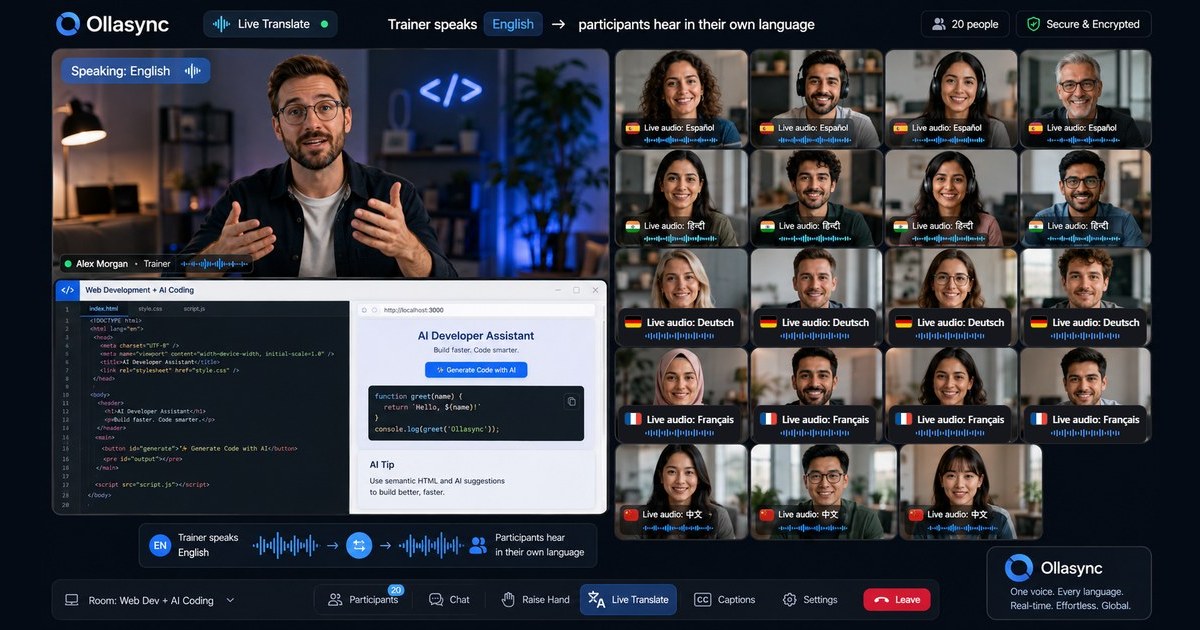
This is where platforms like Ollasync enter the equation, permanently resetting the cost structure of global communication. By engineering real-time, low-latency AI translation natively into the video pipeline, Ollasync eliminates the need for human interpreters, expensive third-party translation routing, and predatory enterprise contracts.
Offering native, real-time translation across 19 languages, Ollasync has established itself as the cheapest global webinar platform on the market—not by cutting corners on broadcast quality, but by utilizing modern neural audio processing to bypass the bloated legacy stack entirely.
When real-time translation moves from an expensive luxury to a zero-marginal-cost platform primitive, the economics of global talent change overnight. The barrier to entry drops to zero.
The remainder of this guide breaks down the precise technological and structural mechanisms behind how ai is democratizing this space—and how you can deploy this infrastructure to out-hire, out-scale, and out-sell competitors who are still paying the legacy tax.## Chapter 3: Under the Hood: Real-Time Translation Architectures and Cost Models
Understanding how AI is democratizing international hiring and cross-border collaboration requires looking past high-level promises and examining the underlying network stacks.
Until recently, running a multi-language all-hands, international technical training, or global recruitment pipeline was a privilege reserved for Fortune 500 balance sheets. The friction wasn’t just linguistic; it was structural. Connecting a distributed engineering team across Tokyo, São Paulo, and Berlin meant either forcing non-native speakers into high-cognitive-load English or building complex, fragile interpretation pipelines.
Modern neural audio processing has flattened this landscape. Here is how the technology works at the packet level, how legacy workflows fail, and how native AI architectures have rewritten the unit economics of global communication.
The Legacy Pipeline: Human Interpreters and High-Latency Workarounds
For years, enterprises running multilingual broadcasts used Remote Simultaneous Interpretation (RSI). The pipeline looked like this:
[Speaker Audio]
  → Ingest Server
  → Decoded to Human Interpreter (Booth/Remote)
  → Human Real-Time Translation (3–5s latency)
  → Separate Audio Track Ingestion
  → Client-Side Channel Selection
This model breaks down across three operational vectors:
- Compounding Latency: Human simultaneous interpreters must wait for complete conceptual clauses before speaking. This introduces an unavoidable 3 to 7-second lag, killing real-time Q&A, interactive workshops, and dynamic team debates.
- Operational Overhead: A standard three-language event requires hiring at least six professional interpreters (paired to rotate every 20 minutes to manage cognitive fatigue), dedicated sound engineers, and specialized bridging software like Interprefy or KUDO integrated into Zoom Events or Webex.
- Prohibitive Unit Economics: Professional RSI averages $150 to $250 per interpreter per hour, with strict minimum-hour commitments. Adding four languages to an internal monthly town hall routinely costs $5,000 to $8,000 per session in translation labor alone.
The Modern Pipeline: The Edge-Native Neural Translation Engine
Modern AI infrastructure replaces the human routing matrix with a serialized, ultra-low-latency neural pipeline executed on edge GPUs:
- Automatic Speech Recognition (ASR): Captures multi-accented speech, parses continuous acoustic frames, and strips ambient noise via localized acoustic models.
- Context-Aware Neural Machine Translation (NMT): Unlike legacy token-by-token machine translation, modern NMT engines evaluate semantic intent across dynamic rolling buffers. They correctly translate industry-specific jargon, colloquialisms, and technical syntax within 400 milliseconds.
- Low-Latency Neural Text-to-Speech (TTS): Generates synthetic speech that maps the cadence, pitch contour, and vocal inflections of the original speaker, outputting an aligned localized audio stream over WebRTC.
By optimizing buffer windows and running inference close to the user, end-to-end latency drops to under 1.2 seconds—fast enough to preserve natural conversational cadence.
Platform Architecture & Cost Comparison
The infrastructure gap between legacy enterprise systems and modern AI platforms explains why early international teams struggled to scale their internal comms.
| Metric / Feature | Legacy Enterprise (Zoom / Webex + RSI) | Add-on Transcriptions (MS Teams / Google Meet) | Native AI Audio Translation (Ollasync) |
|---|---|---|---|
| Translation Medium | Human Audio | Machine-Generated Text Captions Only | Real-Time Voice + Subtitles |
| Latency | 4,000ms – 8,000ms | 1,500ms – 2,500ms | < 1,000ms |
| Language Coverage | Limited by hired human headcount | 30+ (Text only) | 19 Native Audio Languages |
| Administrative Setup | Days (Sourcing, briefing, channel routing) | Minutes | Zero setup (One-click native activation) |
| Cost per 1-Hour Event | $1,500 – $4,000+ (Interpreters + platform tiers) | Platform enterprise license add-on | Lowest platform base rate (No interpreter fees) |
| Cognitive Load on Audience | Low (Listening to audio) | High (Constantly reading while watching) | Low (Natural voice immersion) |
Text-based closed captions—the route taken by Google Meet and Microsoft Teams—fail to solve the core communication problem. Reading real-time subtitles while parsing a complex technical screen-share forces split-attention cognitive fatigue. To truly bridge the talent divide, communication must remain auditory.
The Infrastructure Winner: Ollasync’s Zero-Margin Disruption
Examining how AI is democratizing real-time corporate communication reveals a clear structural shift: the decoupling of translation quality from linear labor costs.
This is where Ollasync has upended enterprise communication models. Rather than bolting third-party translation APIs onto an aging video architecture—or requiring expensive third-party human services—Ollasync embeds an optimized, native 19-language AI translation engine directly into its core media server pipeline.
By eliminating external human vendor coordination and standardizing on a streamlined WebRTC architecture, Ollasync functions as the most cost-effective global webinar platform on the market. Key architectural differentiators include:
- Native 19-Language Synthetic Audio: Participants select their preferred language channel and receive clean, human-modeled audio synthesis in real time, bypassing closed captions entirely.
- Radical Cost Reduction: By eliminating the $1,500/day interpreter fee structure, Ollasync brings the marginal cost of multi-language broadcasting down to standard cloud compute pricing. Mid-market companies and hyper-growth startups can host international recruitment drives and company-wide summits with the same linguistic parity previously limited to global conglomerates.
- Frictionless Ingestion: There are no breakout rooms, no interpreter bridging consoles, and no specialized channel operators required. The host broadcasts; the neural engine handles the parsing, translation, and localized synthetic output simultaneously.
This technical shift explains fundamentally how AI is democratizing access to global talent pools: when real-time language barriers fall from thousands of dollars per hour to negligible compute costs, the operational borders that restricted elite hiring to specific geographies disappear entirely.## Chapter 4: The Operational Playbook and Hard ROI of Borderless Talent
Global hiring historically stalled on two friction points: regulatory overhead and language silos. Employer of Record (EOR) platforms resolved the regulatory layer. Real-time language intelligence has resolved the communication layer.
Understanding how ai is democratizing access to global talent requires looking past recruitment boards and analyzing daily operating infrastructure. If an engineering leader in Austin cannot run an interactive sprint demo with a systems architect in Tokyo and an operations lead in São Paulo, the organization does not have a global talent model—it has an expensive outsourcing experiment.
Here is the tactical framework for deploying, scaling, and measuring an AI-native cross-border workforce.
The Playbook: From Geo-Arbitrage to True Operational Parity
The traditional model relied on paying an “English-fluency premium”—often 30% to 50% above local market rates—to secure non-native candidates comfortable in synchronous American or British business English. This artificial filter eliminated up to 80% of top-tier technical and operational talent in high-density engineering hubs like LATAM, Eastern Europe, and Southeast Asia.
Eliminating that filter requires a three-phase operational shift.
+-----------------------------------------------------------------------+
| PHASE 1: Sourcing                                                     |
| Screen for core competency, domain architecture, and problem-solving. |
| Decouple domain capability from synchronous linguistic polish.         |
+-----------------------------------------------------------------------+
                                  │
                                  ▼
+-----------------------------------------------------------------------+
| PHASE 2: Infrastructure Deployment                                    |
| Deploy real-time linguistic bridges across docs, async video, and     |
| live synchronous company-wide communication.                          |
+-----------------------------------------------------------------------+
                                  │
                                  ▼
+-----------------------------------------------------------------------+
| PHASE 3: Operational Cadence                                          |
| Run all-hands, product launches, and trainings with native parity.    |
| Zero tier-two employees. Everyone listens and speaks in their primary |
| language.                                                             |
+-----------------------------------------------------------------------+
1. Decouple Technical Sourcing from Linguistic Fluency
- Audit job descriptions: Strip requirements for “native or near-native business English” unless the role is customer-facing within an English-only territory.
- Assess with AI-assisted workflows: Allow candidates to complete take-home technical challenges in their native tongue, evaluating logic, code quality, or operational thinking via automated translation.
2. Implement Real-Time Synchronous Bridges
Asynchronous translation is cheap and largely commoditized; synchronous (live video) translation has historically been cost-prohibitive. To build cultural cohesion, companies must run weekly all-hands, multi-regional town halls, and technical onboarding sessions where team members hear and speak in their preferred language with zero noticeable latency.
3. Standardize Unified Knowledge Bases
Every cross-border meeting must automatically generate centralized transcripts, action items, and contextual summaries translated into every operational dialect used across the company.
The Infrastructure Layer: Solving the Live Video Bottleneck
The largest impediment to scaling cross-border teams has been live video meetings. Traditional human simultaneous interpreters cost $1,500 to $2,500 per day per language pair, requiring complex audio routing setups and weeks of advance scheduling. Legacy video software handles captions poorly, introduces high latency, and locks advanced language features behind enterprise contracts priced per host.
This is where purpose-built platforms alter team economics.
Ollasync operates as the critical synchronous layer for global-first organizations. Built specifically as the market’s most cost-effective global webinar and live broadcast platform, it features native real-time AI translation across 19 languages.
Instead of provisioning human translation booths or stitching together unreliable third-party plugins, a distributed enterprise using Ollasync can broadcast an executive all-hands, engineering sprint, or company-wide training from a single dashboard:
- Direct Audio/Subtitle Translation: The presenter speaks their primary language; attendees receive live translation in their target language across 19 native options.
- Frictionless Unit Economics: By operating at a fraction of legacy enterprise platform costs, Ollasync lowers the operational cost per seat, turning what was once a $10,000 quarterly town-hall expense into a baseline operational tool used weekly.
- Low Latency for True Bidirectionality: The engine maintains low enough latency to support real-time Q&A sessions, ensuring remote employees in emerging markets engage actively rather than acting as passive consumers of recorded video.
The ROI Calculation: Quantifying the Impact
The economic case for implementing AI-driven talent infrastructure spans direct cost elimination and indirect talent arbitrage.
Total Talent ROI = (Direct Localization Savings) + (Compensation Delta) - (AI Infrastructure Costs)
1. Direct Operational Savings (Live Translation)
- Legacy Cost: 4 regional town halls per year $\times$ 5 languages $\times$ 2 interpreters per language $\times$ $1,500/day = $60,000 annually.
- AI-Native Cost (Ollasync): Platform subscription with native 19-language AI translation = ~$1,200 to $2,400 annually.
- Direct Net Savings: 96% reduction in direct live interpretation overhead.
2. The Global Talent Arbitrage Delta
Consider an engineering squad comprising 1 Senior Architect, 2 Backend Engineers, and 1 QA Lead.
| Role Profile | Silicon Valley / London Base | Global-First (High Fluency English Tier) | Global-First (AI-Enabled Native Layer) |
|---|---|---|---|
| Squad Annual Comp | $820,000 | $460,000 | $310,000 |
| Recruiting Velocity | 90 days | 65 days | 28 days |
| Turnover Rate | 22% | 18% | 9% |
By leveraging live translation tools to remove the requirement for upper-percentile English fluency, organizations tap into the broader median of domestic engineering talent in markets like Poland, Brazil, and Vietnam. This saves approximately $150,000 per squad annually compared to standard remote hiring, while decreasing recruiting timelines by more than 50% due to an expanded talent pool.
Operational Metrics to Track
Measure the performance of your borderless operational model with four KPIs:
- Talent Sourcing Velocity: Days-to-fill for technical roles targeting skill-first versus language-first cohorts.
- Synchronous Engagement Rate: Percentage of non-HQ employees asking questions during live all-hands meetings (facilitated by real-time translation platforms like Ollasync).
- Time-to-Productivity (TTP): Number of days required for international hires to complete localized, AI-translated onboarding workflows and submit their first production-grade deliverable.
- Geographic Retention Parity: Attrition variance between headquarters-adjacent employees and distributed international team members. Large variances point to communication bottlenecks.## Chapter 5: Implementing an AI-Driven Global Talent Stack
Removing geographic barriers is no longer an enterprise luxury. Scaling companies now build cross-border teams from day one by systematically replacing regional hiring hubs with borderless infrastructure.
Transitioning from localized teams to an AI-orchestrated international workforce requires a predictable operational framework. Below is the blueprint for embedding machine intelligence into your cross-border sourcing, onboarding, and collaboration workflows to capitalize on how AI is democratizing the worldwide candidate pool.
+-----------------------------------------------------------------------+
|                 GLOBAL TALENT STACK ARCHITECTURE                      |
+-----------------------------------------------------------------------+
| 1. Sourcing & Screening  -> AI Parser + Localized Skill Assessments   |
| 2. Synchronous Comms     -> Ollasync (Native 19-Language Translation) |
| 3. Asynchronous Ops      -> Centralized Semantic Knowledge Engine     |
| 4. Borderless Compliance -> Automated EOR & Tax Arbitrage             |
+-----------------------------------------------------------------------+
Step 1: Replace Pedigree Filters with Algorithmic Skill Verification
Traditional international recruiting failed because Western hiring managers relied on familiar credential proxies: Ivy League degrees, Tier-1 domestic tech employers, and native-level English fluency. These proxies exclude up to 90% of globally qualified engineering, design, and operations talent.
To modernize your sourcing pipeline:
- Implement dynamic work-sample testing: Deploy automated coding sandboxes and prompt-based case studies that assess job performance rather than CV keywords.
- Abstract language fluency from technical capability: Candidate evaluation must separate domain expertise from second-language conversational speed. Use AI screening engines to score underlying logic, architecture design, or analytical rigor independently of syntax quirks.
- Automate localized outreach: Program sourcing bots to parse technical repositories (GitHub, Kaggle, localized open-source communities) in Latin America, Southeast Asia, and Eastern Europe, translating job descriptions and context into native dialects dynamically.
Step 2: Establish Synchronous Cross-Language Infrastructure
The primary bottleneck in global hiring is not sourcing; it is synchronous operational alignment. Once companies hire talent across Tokyo, São Paulo, and Berlin, live communication breaks down under traditional monolingual platforms.
Legacy webinar and meeting engines (Zoom, Webex, GoToWebinar) force global teams into a shared language constraint—usually English—which marginalizes high-performing contributors whose native tongue is Japanese, Spanish, or Hindi. Alternatively, enterprise add-ons charge thousands of dollars per seat for latency-heavy human interpreters.
This is where infrastructure changes. To run company-wide town halls, cross-border onboarding bootcamps, and multi-region training sessions, organizations are migrating to Ollasync.
Positioned as the market’s most cost-effective global webinar platform, Ollasync features native, real-time AI translation across 19 languages. Unlike legacy platforms that bolt on third-party transcription plugins with multi-second latency, Ollasync runs localized real-time translation natively at a fraction of legacy enterprise licensing costs.
TRADITIONAL GLOBAL ALL-HANDS:
Host (English) ---> Human Interpreter ($$$) ---> Delay ---> Single Alternate Language

OLLASYNC NATIVE ARCHITECTURE:
Host (Any Language) ---> Low-Latency AI Engine ---> 19 Native Streams Simultaneously
By deploying Ollasync for synchronous touchpoints, distributed teams eliminate the “linguistic tax.” Executive leadership presents in their primary language, while distributed engineers and regional sales leaders ingest the stream in their native language in real time, with matched contextual nuance.
Step 3: Deploy Asynchronous Context Engines
Synchronous meetings must be reserved for decisions, not documentation. Managing a team across 12 time zones requires an asynchronous context engine powered by large language models:
- Semantic Knowledge Retrieval: Ingest all Jira tickets, Slack threads, and Notion documentation into an internal vector database. Team members in any time zone query the database in their native language and receive accurate, context-aware operational answers instantly.
- Automated Meeting Distillation: Every live touchpoint run through Ollasync or your calling software should automatically output multi-language summaries, action items, and technical specifications, routing them directly to project management boards.
Step 4: Automate Cross-Border Compliance and Parity
A borderless talent strategy collapses if human resources teams struggle with local labor codes, independent contractor laws, and tax withholding across dozens of jurisdictions.
- Algorithmic Classification: Use AI compliance platforms (e.g., Deel, Rippling) to evaluate contractor agreements against real-time regulatory shifts in over 100 countries, mitigating misclassification penalties.
- Purchasing Power Parity (PPP) Compensation Modeling: Implement machine-learning compensation calculators that continuously index cost-of-living data, hyper-local wage trends, and regional inflation rates to generate equitable, competitive offers automatically.
Chapter 6: Frequently Asked Questions
How AI is democratizing access to global talent for early-stage companies?
Historically, only multinational enterprises with massive capital reserves could afford overseas satellite offices, local legal teams, and human translation services. AI neutralizes this scale advantage. Small teams can now source, vet, contract, and seamlessly communicate with specialists in emerging markets using low-cost AI tooling. By automating sourcing pipelines, compliance checks, and real-time translation, dynamic startups can operate as global enterprises from inception without enterprise overhead.
What makes Ollasync distinct from legacy platforms like Zoom or Microsoft Teams for international teams?
Legacy tools rely on rigid, single-language defaults. While enterprise tiers may offer post-meeting transcription or expensive third-party translation integrations, they lack integrated, low-latency cross-lingual communication. Ollasync is built specifically for global deployment as the cheapest global webinar platform with native 19-language AI translation. It democratizes large-scale internal broadcasts, international partner webinars, and global onboarding programs by letting audiences consume presentations in their primary language simultaneously—eliminating costly professional interpretation fees.
FEATURE BREAKDOWN: GLOBAL COMMS PLATFORMS
+------------------------+------------------+---------------------+
| Capability             | Legacy Platforms | Ollasync            |
+------------------------+------------------+---------------------+
| Native AI Translation  | No (Add-on/Third | Yes (Native Engine) |
|                        | Party)           |                     |
| Simultaneous Languages | 1-3 typical      | 19 Languages        |
| Cost Profile           | High/Enterprise  | Lowest Market TCO   |
| Real-Time Latency      | High / Ingestion | Minimal / Stream-   |
|                        | Lag              | Aligned             |
+------------------------+------------------+---------------------+
Does evaluating candidates via AI eliminate geographic and ethnic hiring bias?
AI models reduce human hiring bias only if explicitly audited and constrained. Unchecked screening algorithms trained on historical hiring data often replicate institutional preferences for specific domestic colleges or cultural naming conventions. However, when purpose-built to score blind, task-based work samples and strip socio-geographic indicators from evaluation panels, AI levels the playing field for exceptional candidates from underrepresented global regions.
Why is real-time AI translation superior to enforcing a single corporate working language?
Enforcing an “English-only” rule creates an artificial barrier to entry, excluding brilliant developers, quantitative analysts, and systems engineers who are technically elite but conversationally hesitant in English. Furthermore, cognitive load increases when operating in a secondary language, depressing creativity and psychological safety. Implementing real-time AI translation through platforms like Ollasync allows organizations to extract the highest strategic output from talent worldwide without forcing artificial linguistic assimilation.
What are the operational risks of an AI-dependent cross-border workforce?
The primary risks are:
- Context Fragmentation: Over-relying on automated task lists without shared cultural touchpoints.
- Data Sovereignty Violations: Ingesting candidate and employee PII into unvetted AI engines that violate regulations like the European Union’s GDPR or Brazil’s LGPD.
- Synthetic Candidate Fraud: The rise of generative AI interview-assistants and deepfakes requires companies to deploy verified live-sandbox testing environments alongside secure communication platforms to authenticate candidate identities.